Douglas Arvidson is a past winner of the WICE/Paris Transcontinental International Short Story competition. His short fiction has been published in Paris, Prague, and in literary magazines in the United States and he was recently invited to be a staff writer for the Prague Revue, a cutting-edge, online literary journal (http://bit.ly/1mMT6ZC). The novels in his fantasy series, The Eye of the Eye of Stallion, include The Face in Amber, The Mirrors of Castaway Time, and A Drop of Wizard's Blood. His new novel, Brothers of the Fire Star, was selected as a finalist in the ForeWord Reviews 2012 Book of the Year national awards and as a finalist in three categories in the 2013 New Mexico-Arizona Book Awards: Action Adventure Fiction, Historical Fiction, and Young Adult Fiction. It has become part of the pantheon of Pacific literature and is now included in school literature programs. Brothers of the Fire Star is an adventure story set in the Pacific during World War II and concerns two boys of different races and cultures who escape the island of Guam in a small sailboat when the Japanese army invades. They must then struggle to survive as they master the secrets of the ancient Pacific navigators. Appropriate for young adults as well as adult readers, Brothers of the Fire Star is available on Barnes & Noble, Amazon.com (http://amzn.to/1j3axVk) and Crossquarter.com. Visit the author's website: douglasarvidson.com


Friday, October 28, 2011

Occupy Wall Street: While the Oakland, CA protests Errupts, I Visit the (thus far) Peaceful Occupy D.C. Camp to Find Out the Truth

Welcome to McPherson Park, home of the Occupy D.C. Movement

Readers of this blog know by now that I love our nation's capitol and go there a few times a year. I hang out, wander the galleries and museums, argue with the political nuts in front of the White House, join in demonstrations, eat at good restaurants, and take in a show or two at the National or Warner Theaters.

I like it that the streets are filled with smart, 30-something professionals dressed in suits, that there are lots of college students doing college students things, that profound thoughts are chiseled in the ubiquitous marble facades, and especially the feeling one gets that you are where the action is. For a political junkie like me, that's important. Look, see that pretty woman leaving the White House? I see her on CNN every night. Golly!

So, after driving across the country with my son (I'll start that travel log in the next blog entry), I flew from Ft. Lauderdale to D.C. to meet my wife who was there for the week on business. That's how I got to see and meet the Occupy D.C. movement.

First impressions are ever so important, so here's mine: I don't know what caused the fracas in Oakland, but the nation's capitol need not yet call up the National Guard to deal with  their protesters. No worries. This is a rag-tag band, for certain, and while they decry the greed of the Wall Street robber barons and long for the District of Columbia to have representation in Congress, peaceful demonstration is their bottom line.

Indeed, having lived through the 1960's as a college student and having been at the student draft card burnings in Boston, and having been on the snarling end of attacking police dogs on the Boston Public Garden (the dogs were leashed, but effective), I can testify to the peaceful intentions of these neo-hippies.


The food tent area.

One thing about the 60's that was not present and that I missed, was the folk music. No budding Peter, Paul, and Marys here, just young people sitting around talking. Every night they hold a general membership meeting at which anyone can say their piece and receive either accolades or dissing from the crowd. If their ideas are deemed good and acceptable, hands are raised and fingers waggled in the air. If the ideas are not so good, hands go down and fingers are waggled toward the ground. No one gets shouted down. I'd love to see Congress adopt this method. Imagine.


Civil War General James Birdseye McPherson watches over the Occupy D.C. camp.

So, exactly what is the gripe? It was hard to pin it down. According to a young man named Joe who I interviewed in the headquarters tent, the Occupy movements in different cities have no central leader and have different motivations layered on top of the basic anti-greed, anti-Wall Street-Congress collusion problem. D.C. as I mentioned, is taxed but has no representation in Congress. Other places have other issues.

Joe and I discuss the meaning of the Occupy D.C. movement. He was sitting at tent labeled, "Information."

But now it seems the patience of city officials is wearing thin. At least in Oakland, CA where it was rumored that some protesters chucked stones at police and police responded with tear gas. A few people were injured. See below.


What's the meaning of it all? I guess it's all part of the zeitgeist, the spirit of the age. Our spirits have been brought low by the misery of the economy and the economy is a global phenomena of nearly infinite complexity so no one has any real solutions. What results is like a brain surgeon using an axe while politicians and corporations stand around yelling instructions and making accusations. Now we, the common man-as-patient are trying to come out of our anesthesia and do something--anything.

Friday, September 30, 2011

The Other Aspects of a Writer's Life: Clinging to the Irrational Belief that My Sailboat Has a Soul

Seawind, our Alberg 30, on the hard

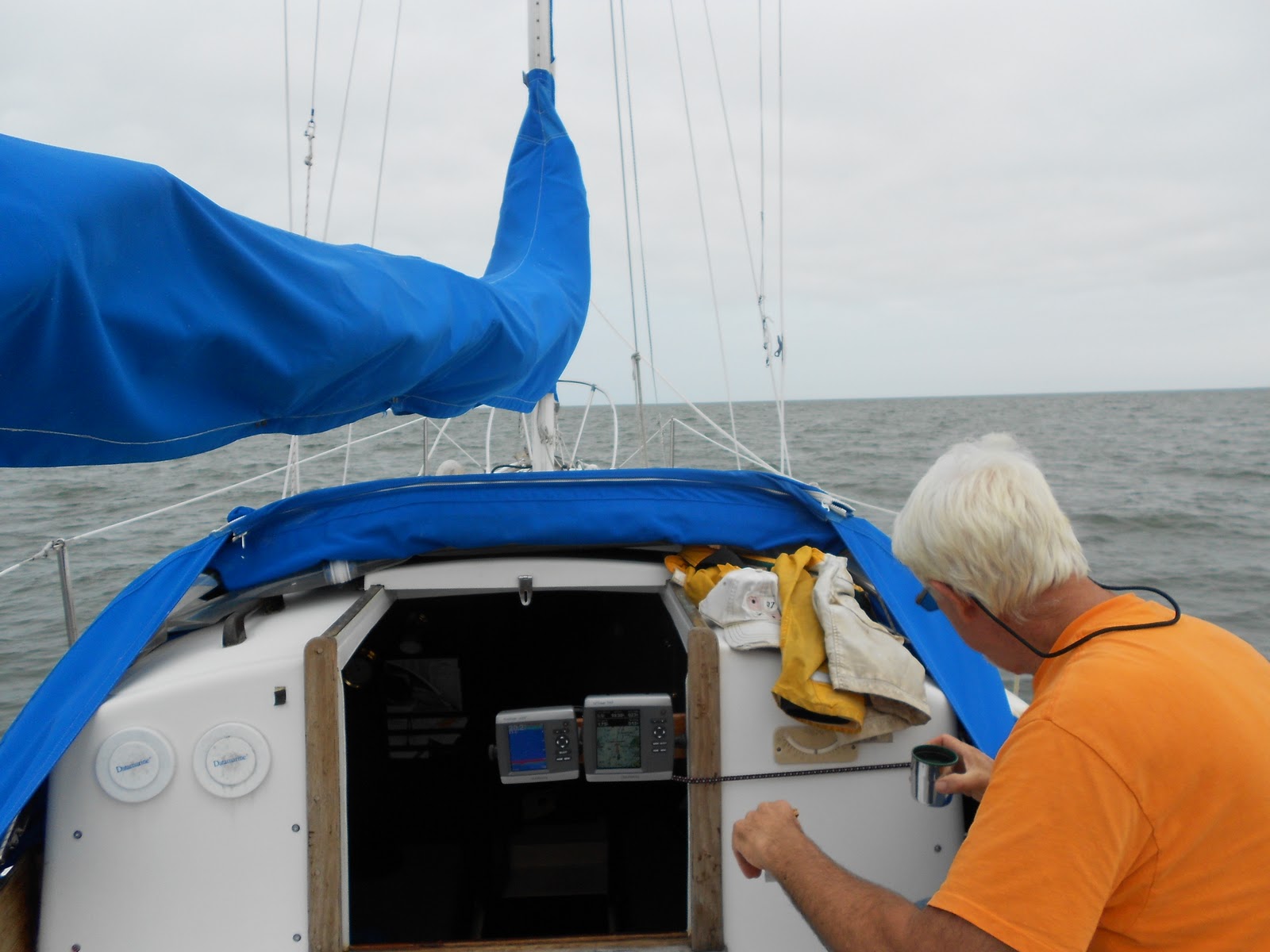
I'm a sailor; been one for a long time. Can't imagine a life without boats and my sweet 30-footer makes me sigh every time I look at her. We bought her up in Long Island two summers ago and my brother and I sailed her down here to the lower Chesapeake. She lives at a nice little marina just a short drive from our house and just at the edge of the Bay.

This brings me to the tao of sailing which is the boat itself. A beautiful sailboat is an essence, a distillation of complex things. It's a phenomena, a cause of contemplation. It causes a certain madness brought down to a fine point. In short, I have this irrational feeling that my boat is alive. It seems so obvious; she breathes, feels, desires, responds to love as well as to neglect.

Yes, I believe it because I'm projecting my living self onto the boat and so, of course, reductio ad absurdum, she lives, too. She absorbs my projections like a house--and we all know houses live and breath. It's a hangup we can enjoy like so few of our other hangups.

In any event, it's nearly winter, a bad time for northern sailors. It's a time of guilt and regret at not having paid more attention to the boat's needs, not having sailed more or finished the woodwork project started in the spring.  So, I decided to haul her out and give her a little bottom paint and change the zinc before putting her back in for the winter.

Glad I did. The modified ablative paint the marina in Long Island put on her had some strange things happening to it. Little blisters had formed, with water getting in under the paint but the gel coat/barrier coat look okay. The zinc still had a lot of life left in it.


My friend and fellow sailor, Denny, helped me bring her up to the boat yard, a three-hour trip--no wind, motoring the whole way.


When we got there, the lift was ready. I drove her into the slings and out she came.


A good, long, hard, high-pressure shower took off most of the barnacles and slime.

I'm going to let her dry out for two or three weeks before sanding and painting. In the meantime, I'm off to San Francisco tomorrow and will drive back across the country with my son, the yacht captain, whose 112' Westport is being loaded on a container ship and moved to the East Coast where they will cruise the Bahamas and the Caribbean for a while.

Looking forward to some father-son time and the adventure of a long road trip. I'll be reporting here.

Friday, September 23, 2011

Writing Down the Angst: A Chicken's Great Escape

Yes, this is a dead chicken.

I love my little Nikon Coolpix camera. It slips into my pocket and I can carry it everywhere with barely a bother. This allows me to take quick snapshots of life as it is lived and later I find the images instructive when I'm ruminating about how things are going, generally.

Take this dead chicken. Where I live on the Eastern Shore of Virginia, they raise a lot of chickens. Tyson and Perdue have big chicken processing plants here and there are lots of chicken farmers to supply them with fresh,  young chicken, as the advertisement goes.

You often pass one of their trucks, loaded with cages of chickens, going to the slaughter. Or worse, you get stuck behind one and get to watch the poor creatures stuffed into their small spaces, eyes glaring, their dirty feathers fluttering in the wind. It always reminds me of the day forty-five years ago, when I was shipped off to Army basic training at the height of the Viet Nam War. Oh, the sorrow, the remorse, the feeling of helplessness, the sense of doom. Every time I see one of those trucks, I consider the merits of both pacifisim and vegetarianism.

And then, every so often, you see this. One of them, somehow, escapes. But how? The cages are stacked up, chockablock, the space between the bars must be too small for them to slip through or they'd all be out. Imagine that.

No, how this one gained it's freedom will remain a mystery. Did it see an opportunity and seize it in the best tradition of escapees? Did it bribe a guard? Did it peck off the lock and then try to convince its cell mates to make a break with him and finally have go it alone? Was this one of those extremely rare chickens gifted with brains and daring?

In any event, chickens can't fly and the heady, desperate feeling of freedom did not last long for this fryer leaving me to spend the next few miles wallowing in existential angst and contemplating the true meaning of freedom, life, and death, etc.

But let's leave this on a positive note. Here, to counteract that sense of doom, are a couple a pure white Morning Glory moon blossoms that were growing in my garden the same morning that I encountered the chicken. Come to think of it, these lovely blooms only last for a short time, too. Oh, the angst, the angst.


Wednesday, September 7, 2011

Dylexia: The Common Wisdom is Wrong


Dyslexia is used by some people as a convenient excuse for failure: Why is the common wisdom of the disorder so wrong?

A family member of middle age recently announced at a gathering that she now knew what her problem has been all these years: She has dyslexia. No wonder she wasn't a good student. No wonder.

I bit my tongue and kept quiet so as not to burst the sparkling, hopeful bubble of her excuse for what was apparently a mediocre academic performance back in her student years. As a speech-language pathologist, I spent thirty-two years of my life diagnosing and treating language and learning disabilities and the "symptoms" she used to describe her dyslexia fit nicely with the received common wisdom about the disorder: seeing things "backwards," her eyes jumping around on the page.

And this morning on NPR online, there it was again. In an interview with a business school professor about why an inordinate number of successful business people have the disorder, Steve Inskeep, the host, defined dyslexia as "seeing things backwards." Not so, Mr. Inskeep, not so.

Here's the definition of dyslexia I used when describing the disorder to parents:

Dyslexia is difficulty learning to read given normal intelligence and adequate instruction.

So, say a child reaches third grade, has had good, consistent teaching, and testing indicates at least average intellectual abilities, and that child still has great difficulty reading, he or she, by definition has dyslexia. But is that child just seeing words "backwards?" Unfortunately no; that might be an easy fix.

No, true dyslexia almost always is not problem with vision or your eyes not able to "track" words on a page. Dyslexia is a problem processing and associating sounds with symbols. It is primarily an auditory processing disorder. Here's a good description of the symptoms. I found it on line at PubMed:

A person with [dyslexia] may have trouble rhyming and separating sounds that make up spoken words. These abilities appear to be critical in the process of learning to read. A child's initial reading skills are based on word recognition, which involves being able to separate out the sounds in words and match them with letters and groups of letters.

Because people with [dyslexia] have difficulty connecting the sounds of language to the letters of words, they may have difficulty understanding sentences.


True dyslexia is much broader than simply confusing or transposing letters, for example mistaking ”b” and “d.".

In general, symptoms of [dyslexia] may include:


•Difficulty determining the meaning (idea content) of a simple sentence


•Difficulty learning to recognize written words


•Difficulty rhyming


[Dyslexia] may occur in combination with writing or math learning problems.

You notice that rhyming is mentioned twice here and that can be a first indicator of looming dyslexia. When a kindergartner seems to be having trouble learning those critical sound-symbol associations and also seems to have trouble rhyming, alarms should go off (gently but insistently).

It is critical with dyslexic children to get a diagnosis early and to get help sooner rather than later. When a young student falls behind in the acquisition of reading skills that delay will quickly widen as his or her peers move forward. The critical skill to learn in school is how to read and when a child's reading skills lag, the results can be disastrous.

But as for adults using "dyslexia" as an excuse for failure in life, remember this: a diagnosis of dyslexia should only be based on tests administered by professionals in the field. If you had a terrible time leaning to read as a young student, yeah, maybe your disorder was missed and you are a dyslexic. However, if you were an unremarkable student who nonetheless progressed normally through school and learned to read for meaning by the end of third grade, you may just have, heaven forbid, "average" intelligence. And that might be the only thing worse than dyslexia as we try to compete in this high tech world that worships those with gifted minds.

Monday, August 29, 2011

Hurricanes and Quakes: What Doesn't Hurt There, Kills Here

Irene bears down on us here on the Eastern Shore of Virginia

Comparisons can be useful. I got an email from a friend on the island of Guam, where I lived on a sailboat for eleven years and went through three super typoons (Cat. 5's) and some earthquakes that were up there around 6 to 7 or even a 9 on the Richter Scale. On that far-off speck in the western Pacific, our piddling little earthquake last week and our relatively meek and mild hurricane of this week would have been non-events. Scant notice would have been taken of the earth moving and Irene would have fallen in the "banana" storm catagory; that is, just strong enough to take the bananas off the trees.

But of course, comparisons like this are misleading. Guam has evolved to take this kind of punishment. The houses are mostly made of reinforced concrete and there are no big trees to mention (and that's because they can't grow big due to the frequency of the typhoons that blow them over). Huge storms and major quakes are a fact of life on Guam and the people have adapted. In 1997, when Typhoon Paka hit the island with 200+ mph winds, there was not a single storm-related death.

Here on the eastern seaboard of the U.S., though, things are very different.
While hurricanes occur every year, they mostly affect Florida and the Caribean islands. A direct hit along the length of the east coast is rare. And so, we  have big trees, forests of them, and houses made of wood and lots of trailer parks with cockleshell mobile homes sitting on cinder blocks with those big trees hanging over them. And there are lots of mountains with rivers and streams pouring out of them and lots of people with little experience dealing with big storms.

The end result: When Irene's 40 to 80 mph winds and 12 inches of rain had finished passing through, 40 people had died due to the terrible flooding (Vermont and Massachusetts are in real trouble and the death toll keeps rising) and houses and cars being crushed by falling timber, and I'm certain that the final bill will be in the billions of dollars.

We got lucky. Big trees surround our house on the Eastern Shore of Virginia but only one came down and by raw luck, missed the house and the TV satellite dish. Better than that, before the storm I made a last-minute decision to move my powerboat; it was parked right there. And my wife had always wanted that tree removed, so that project was taken care of for me.


An ode to inovation: We went up to my mother-in-law's house to ride out the storm with her. This is the generator that my father-in-law (who died last December) had cobbled together from wood and spare parts. It ran perfectly.

Friday, August 12, 2011

The World in Financial Toil, Boil, and Trouble: Are We Literary Looters?


The Fire This Time: Looting for the Loot in London

It's all about the money, honey. Making it, spending it, and worrying about it, mostly. As the world markets continue to plunge down deep into black-hole depths led by the imploding confidence of America's financial Masters of the Universe, we here on the literary blogosphere continue to fiddle while London burns.

And what are we fiddling around about? Tell me it's not about just money and fame, fame and money. It's about writing good--maybe great--prose, isn't it? Still, just look at the re-tweet I was tempted to send this morning. It essentially gave advice on How to stalk your potential client without them thinking they're being stalked.

It's not possible that we writers, we high priests of the moral intellect, we wise seers of the human condition, are really looking only at the bottom line, but just in case it is, here are some slang terms for money from Len Penzo.com so when we writers hit it big, viz a viz J.K. Rowling, we can diversify our lingo a bit:

1. chips
2. bread
3. dough
4. roll
5. cabbage
6. lettuce
7. kale
8. bacon
9. clams
10. coconuts
11. beans
12. fish
13. potatoes
14. bananas
15. buckaroos
16. bucks
17. fins ($5-bills)
18. sawbucks ($10-bills)
19. C-notes ($100-bills)
20. hundies
21. Benjamins
22. Jacksons
23. grand
24. Gs
25. K
26. smack
27. smackers
28. wampum
29. bills
30. moolah
31. means
32. checks
33. drafts
34. shrapnel
35. wad
36. plaster
37. bankroll
38. capital
39. finances
40. currency
41. funds
42. gold
43. stash
44. cash
45. bundle
46. fortune
47. lucre
48. chump change
49. pin money
50. shekels
51. resources
52. boffo
53. spending money
54. doubloons
55. wherewithal
56. treasure
57. dibs
58. bits
59. dollars
60. dinero
61. pesos
62. bullets
63. coin
64. simoleons
65. silver
66. pelf
67. tender
68. scrip
69. pittance
70. guineas
71. gelt
72. bones
73. stake
74. pap
75. spondulicks
76. quid
77. pocket money
78. specie
79. jack
80. change
81. scratch
82. mite
83. king’s ransom
84. mint
85. paper
86. loonies
87. mazuma
88. pieces of eight
89. frogskins
90. long green
91. folding green
92. green
93. greenbacks
94. riches
95. rivets
96. big ones
97. banknotes
98. dead presidents
99. chits
100. scrilla
101. loot

Monday, August 8, 2011

I Finish the TAO OF TRAVEL: In Search of the Life-Altering Epiphany

Me in Vladivostok in 1995: Theroux hated this "clammy-cold harbor city": We found it clean and the people friendly.

I would have loved to have been a roach climbing along the wall of Paul Theroux's cabin as he traveled by train across the world's third-world. I would have been privy to a balding, past-middle-age American man as he ate his rice and beans from a tin cup and scribbled in his notebooks occasionally looking out the window at the passing corruption and endless poverty. He probably had not changed his clothes or shaved or showered in a couple of days and the tropical heat must have rendered him full ripe by then. It is, of course, the only authentic way to travel or to be a travel writer: fully ripened.

I've spent the past twenty-five years traveling around the United States, around Asia, around Europe, and then in one memorable summer, around the world via the Trans-Siberian railroad, that most storied of rail lines. So when Theroux took the time to put together what amounts to a primer on the travel writing experience, it was the first book I read on my new Nook.

I say "primer" because during my pleasant and nostalgic passage through The Tao of Travel it became obvious that that is what one may consider this book to be. It's a how-to book, it's inspirational, and, maybe most helpful, it provides a list of great/famous/infamous travel writers along with not only a sample of their writing, but the low down on their often strange and/or wonderful personality quirks.

Theroux likes those travel writers who do it the hard way. Like Sir Richard Burton, the 18th century skeptic and hard-core traveler/explorer who was obsessed enough with experiencing Mecca first hand that he had himself circumcised, learned Arabic, and boned up on the Koran so he could pass himself off as a real Muslim. Finally, when faced with the great stone monolith that is the heart of Islam and the milling throngs of pilgrims,  Burton had a life-changing, mystical experience that he lived to tell about--the only non-Muslim to do so. For Theroux, this is the ultimate tao of travel--travel as hard-won, heartbreaking epiphany.

Sometimes, when Theroux and I have been to the same place, we disagree on its merits or drawbacks. Take Vladivostok, that forbidding, far-eastern outpost of Mother Russia. Theroux warns against going there, describing it as a "clammy-cold harbor city of vandalized buildings, scrawled-upon walls, underpaid sailors, and confrontational drunks and skinheads."

It may well be as he describes it, if you look for it. But when my wife and spent three days there prior to boarding the Trans-Siberian, it was June and the weather bright, sunny, and cool. The sailors were there, certainly, but they were mostly interested in ogling the bikini-clad young women who were sunning themselves near the harbor than in causing trouble.

We walked, unmolested, throughout the town, along the attractive shopping area, ate well at local restaurants, and observed the rusting Russian Pacific fleet tied up in the harbor. We happened to arrive on the weekend they were celebrating the Russian fishing fleet and there was music and dancing and feasting with families strolling about enjoying the sunshine.

We did encounter young men who could be described as skinheads, but even they were in fine, non-aggressive moods. Better than that and just as indicative of the sense of the place, we saw lots of young women strutting their stuff in super high heels, short skirts, and stockings, apparently the fashion statement of the year.

On the down side, and to give Theroux his due, we flew in from Korea in a decrepit Russian airliner with graffiti scrawled on the back of the seats, arriving on a cloudy day and the Stalin-era buildings on the outskirts of the city were grim and oppressive. In fact, we learned later that there had been no hot water in the city all winter. We stayed in a gray and forbidding looking hotel but, in true Russian form, our room was on a floor that was reserved for foreign tourists, military officers, and high ranking government officials and so was sexed up with new plumbing and carpeting and had a good bar/restaurant. The other floors of the hotel were off limits and we were not allowed to explore.


My wife with our lunch of blinis with caviar in Vladivostok: No roaches on the walls.

In any event, it's not just foreign places that Theroux advises avoiding. He points out that certain cities in the United States hardly qualify as safe and delightful travel destinations. He describes East St. Louis, Illinois as one of the most "menacing-looking" cities in the U.S. and adds Newark and Camden, N.J. to that list of awful places to be avoided because they are among the most dangerous places in the world.

So, back to our train ride with Mr. Theroux: In the form of a roach, Kafka like, I crawl up to Mr. Theroux's tin cup and nosh on a piece of leftover rice while he nods off, his head down on his open notebook. I'd love to read a bit of what he has written but I'm a roach and so, of course, I can't. Instead I eat and listen to his steady, light snoring and watch out the window as the third world passes and our writer dreams perhaps of hot showers, cold beer, a good clean shirt, and that elusive goal of all great travelers: the epiphany around which one can write a book.